
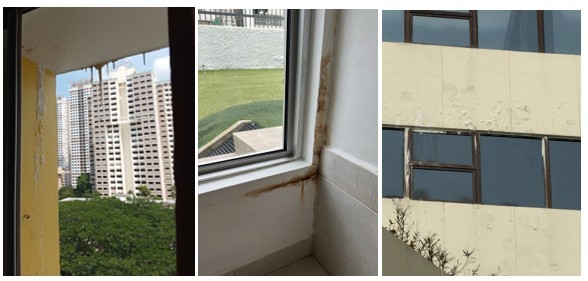
Singapore experiences frequent heavy rain, high humidity and year-round temperature changes. Over time, these environmental conditions can affect the condition of building façades, exterior wall finishes, window joints and concrete structures. When the protective layers of a building deteriorate, rainwater may enter through small openings and eventually appear as damp patches, peeling paint, wall brown stained marks or even a ceiling leak.
For homeowners, the problem often begins with something that seems minor. You may notice a small patch of water seepage on a bedroom wall after a heavy downpour, a stained ceiling near a window, or paint bubbling along an external wall. In a condominium, the same problem may become a concern for the management corporation (MCST), particularly when water ingress affects several units or common areas. In older commercial buildings, recurring leakage can disrupt tenants, damage interior finishes and lead to repeated maintenance expenses.
The visible damage does not always reveal the actual source of the water. Rainwater may enter through exterior wall cracks, window-frame joints or a deteriorated waterproofing system before travelling through the concrete substrate and appearing somewhere else inside the building. Similarly, a suspected exterior water seepage problem may actually be caused by a concealed pipe leak or an inter-floor leak from an upper unit.
Simply repainting a stained wall or covering a damaged ceiling board may improve its appearance temporarily, but it does not necessarily stop the water from entering.
The effective waterproofing is to identify the source of the leakage, understand the condition of the affected structure and select a suitable waterproofing solution treatment.
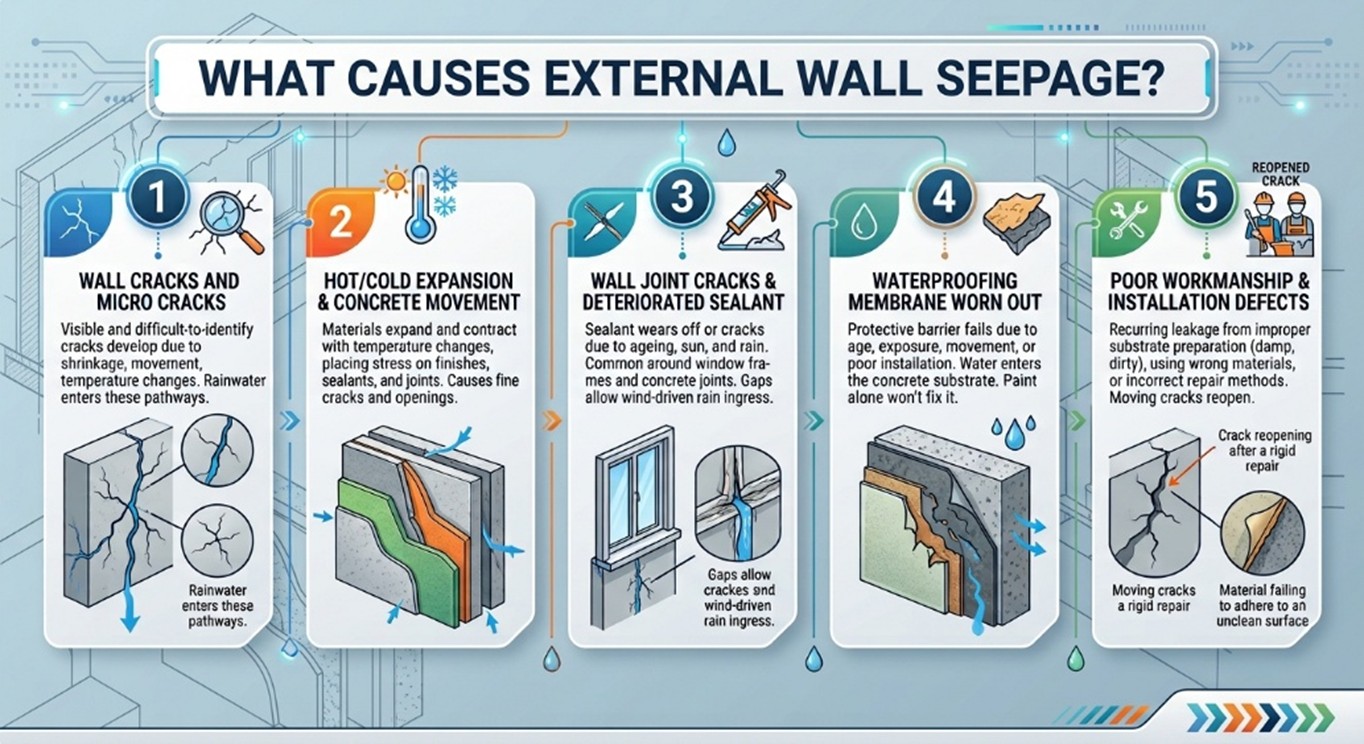
What Causes External Wall Seepage?
External wall seepage occurs when water penetrates through defects or vulnerable areas of a building’s exterior. These defects may develop gradually because of ageing, environmental exposure, building movement or inadequate installation.
Understanding the possible causes helps homeowners and property managers avoid spending money on repairs that only treat the visible symptoms.
1. Wall cracks and micro cracks
Wall cracks are one of the common pathways through which rainwater can enter a building. Some cracks are visible to the naked eye, while micro cracks may be difficult to identify without a close inspection.
Small cracks can develop in plaster, concrete or exterior wall finishes due to shrinkage, structural movement and repeated temperature changes. During heavy rain, water may penetrate these openings and travel through the wall.
Not every crack indicates a serious structural problem. However, cracks that continue to widen, reappear after repair or occur alongside persistent water seepage should be assessed carefully.
2. Hot/cold expansion and concrete movement
Building materials expand and contract as temperatures change. This process, commonly described as hot/cold expansion, can place stress on wall finishes, sealants and joints over time.
Repeated expansion and contraction may contribute to:
- Fine cracks in exterior plaster and paint finishes.
- Separation between different building materials.
- Deterioration of sealant around windows and wall joints.
- Small openings that allow wind-driven rain to penetrate the building.
In some cases, concrete grouting expansion or shrinkage-related movement and defects in grout materials may contribute to cracking around repaired areas or joints. The exact cause should be established before selecting a repair method.
3. Wall joint cracks and deteriorated sealant
External walls contain different interfaces, including joints between concrete elements, plastered surfaces, window frames and adjoining materials. These areas may be more vulnerable to water ingress if the joints are not properly sealed or maintained.
A common issue is sealant worn off due to heat expansion, ageing or prolonged exposure to sunlight and rain. Once the sealant loses adhesion or develops cracks, rainwater may pass through the gap.
Seal damage around window frames is particularly important because water can enter around the frame perimeter and travel into the surrounding wall.
Replacing the sealant may be appropriate where the joint is the confirmed source of leakage. However, if water is entering through the window assembly, exterior wall cracks or another concealed pathway, sealant replacement alone may not solve the problem.
4. Waterproofing membrane worn out
A waterproofing membrane acts as a protective barrier against water penetration. Depending on the building design, waterproofing systems may be used in exposed areas, balconies, roofs, wet areas and other locations where water protection is required.
Over time, a waterproofing membrane worn out by ageing, exposure, movement, damage or poor installation may no longer perform as intended.
This can result in waterproofing failure, allowing water to enter the underlying concrete substrate or adjoining building components.
It is important to distinguish between a deteriorated coating and a failed waterproofing system beneath the surface. Applying another layer of paint may not restore the original waterproofing performance if the underlying membrane or substrate has already failed.
5. Poor workmanship and installation defects
Poor workmanship can contribute to recurring water leakage, particularly when the substrate was not properly prepared, cracks were not repaired correctly or unsuitable materials were used.
For example, applying a coating over a damp, dirty or unstable surface may affect adhesion. Likewise, filling a moving crack with an unsuitable rigid material may result in the crack reopening.
A proper waterproofing solution should consider the condition of the substrate, the likely movement of the joint, exposure to rain and the compatibility of the selected repair materials.
Different property types involve different access arrangements, responsibilities and practical limitations.
External wall rain seepage can affect different types of properties, from HDB flats and condominiums to landed houses and commercial buildings. Although the visible symptoms may look similar, the cause of the leakage, access arrangements, repair responsibilities and available waterproofing methods can vary considerably.
In Singapore, external walls are exposed to frequent heavy rain, high humidity and temperature changes throughout the year. Over time, these conditions can contribute to cracks in the wall surface, deterioration of mortar joints, failed sealant and damage to existing waterproofing coatings. Rainwater may enter through these defects and travel through the wall or concrete substrate before appearing indoors as damp patches, peeling paint or wall brown stained marks.
According to the Building and Construction Authority (BCA), rainwater commonly enters external walls through joints and cracks. Depending on the wall material and thickness, water absorption and permeation may also contribute to seepage. Therefore, effective waterproofing requires the source of water ingress to be identified before selecting a suitable repair method.
1. HDB Flats:
For HDB flats, rain seepage may occur when external façade walls develop cracks or deteriorate through ageing and weather exposure. During heavy rain, water may enter through these openings and appear on the interior side of the wall as damp patches, peeling paint or persistent moisture.
Possible causes include:
- Hairline cracks in external wall finishes.
- Deteriorated joints between building components.
- Damaged or weathered exterior protective coatings.
- Water entering through window perimeters or other vulnerable joints.
- Roof leakage affecting units on the uppermost floors.
Access and repair responsibilities:
For HDB flats, external façade walls are generally common property managed by the respective Town Council. Homeowners experiencing suspected external wall seepage should report the issue to their Town Council for investigation and follow-up. HDB may provide technical assistance for complex or recurring cases.
This is important because homeowners may not be permitted to carry out exterior façade repairs independently, particularly when the work involves common property or requires access to the building exterior. The appropriate party should be consulted before engaging a contractor to undertake such works.
Possible waterproofing solutions:
Depending on the findings, the repair may involve:
- Repairing cracks and deteriorated sections of the external wall.
- Reinstating damaged plaster or other wall finishes.
- Applying a suitable exterior waterproofing coating where required.
- Repairing defective joints and replacing deteriorated sealant.
- Carrying out additional targeted repairs if water continues to penetrate through identified cracks or joints in the concrete structure.
In suitable cases, PU Injection grouting may be considered as an additional measure to seal identified water pathways through concrete cracks or joints. However, it should not automatically replace external wall repairs where the primary defect is on the exterior surface.
For example, if rainwater enters through a cracked external wall finish, repairing the exterior defect is generally an important part of addressing the source. Internal PU Injection grouting may help seal a suitable leakage path from the inside, but its effectiveness depends on the location and condition of that path.
For more information on HDB maintenance responsibilities, homeowners can refer to the official HDB guidance on home maintenance and Town Council responsibilities.
2. Condominiums:
External wall rain seepage in condominiums can be more complicated because the affected wall may form part of the building’s common property. A leak inside an individual unit does not necessarily mean that the source or responsibility lies entirely within that unit.
For instance, a bedroom wall may develop damp patches after heavy rain because water is entering through a façade crack several metres above the affected area. Alternatively, the leakage may originate from a window joint, balcony junction, roof edge or another building component.
Possible causes:
Common causes of external wall seepage in condominiums include:
- Cracks in concrete or plastered brickwork.
- Defective joints between precast concrete panels.
- Deteriorated sealant around windows and façade features.
- Failed waterproofing details at balconies or wall junctions.
- Ageing exterior coatings and inadequate previous repairs.
Access and repair responsibilities:
The first step is to notify the condominium’s Management Corporation Strata Title (MCST) and arrange for the suspected leakage source to be investigated.
BCA guidance identifies external walls as common property in condominium developments, although individual components and responsibilities must be assessed according to the applicable arrangements. The MCST generally oversees maintenance and rectification of common property, while owners are responsible for maintaining their individual lots and certain unit-specific components.
Before external wall waterproofing begins, the contractor should coordinate with the MCST on the work scope, access arrangements, required approvals and safety measures. External repairs may involve suspended access equipment, scaffolding or other specialist access arrangements, particularly for high-rise buildings.
Possible waterproofing solutions:
The repair method should be selected according to the affected building component.
- External crack repair:
Repair visible cracks in suitable plastered or concrete surfaces before reinstating the protective finish.
- Exterior waterproofing coating:
Apply a compatible coating system where the wall surface and existing substrate are suitable.
- Joint resealing:
Remove failed sealant and reinstate vulnerable joints using compatible materials.
- Brickwall and mortar repair:
Repair deteriorated plaster or mortar joints where the wall construction and condition require it.
- PU Injection grouting:
Consider injection from an accessible side of the concrete where a suitable crack or joint has been identified as a water pathway.
In some cases, a combination of external surface repair and internal injection treatment may be considered. The exterior work addresses the likely entry point, while the injection treatment may help seal an identified internal leakage pathway. Whether both are necessary depends on the investigation findings.
If the water continues to enter through a failed window joint or an extensive area of defective exterior coating, injection alone may not resolve the underlying issue.
For condominium owners and management teams, the objective should be to coordinate a repair that addresses the actual defect, rather than repeatedly repainting the affected unit or treating only the visible water stain.
3. Landed Houses:
For landed houses, homeowners may have greater flexibility in arranging repairs because they often have more direct control over their property. However, access to upper-storey walls, narrow side passages, boundary walls and roof-to-wall junctions can still be challenging.
External wall rain seepage is particularly frustrating when the same interior wall becomes damp after every heavy downpour. Repainting may improve the appearance temporarily, but the problem can return if water continues entering through the external wall.
Possible causes:
External wall seepage in landed properties may result from several conditions:
- Cracks in plastered brick walls or concrete walls.
- Deteriorated mortar joints between exposed bricks.
- Micro cracks caused by ageing and repeated hot/cold expansion.
- Waterproofing coatings that have deteriorated after prolonged exposure to sunlight and rain.
- Sealant worn off around windows, doors and wall junctions.
- Water entering through roof edges, parapet walls, balconies or other adjoining structures.
- Defective details where different building materials meet.
In older landed houses, previous renovations may also have introduced new joints or interfaces between old and new construction. If these junctions are not properly detailed and maintained, they may become vulnerable to rainwater penetration.
Access and repair considerations:
Although landed homeowners may have more direct control over their property, upper-storey walls and narrow side passages can make external repairs challenging.
Before starting waterproofing works, the homeowner and contractor should establish whether the leakage originates from the external wall, roof, window joints, plumbing or another building component.
If the external wall is shared with a neighbouring property, access may also require coordination with the neighbour. Boundary walls and shared structures should be assessed carefully to establish the relevant ownership and repair responsibilities.
Possible waterproofing solutions:
For landed houses, the following methods may be appropriate depending on the wall condition:
- Brickwall Crack and Mortar Joint Repairs
Repair cracked plaster, damaged brickwork and deteriorated mortar joints by removing loose materials and applying suitable repair materials to restore the affected areas.
- External Waterproofing Coating
Apply a suitable exterior waterproofing coating after repairing cracks and preparing the wall surface. For exposed brickwork, ensure the treatment is appropriate to avoid trapping moisture.
- Window and Wall Joint Resealing
Remove and replace deteriorated sealant around windows and wall joints to prevent water entry, especially where hot/cold expansion has caused the sealant to fail.
- Internal PU Injection Grouting
Where rainwater travels through suitable cracks or joints in the concrete structure, PU Injection grouting may help seal the leakage pathway from the internal side. However, it does not replace repairs to damaged brickwork, exterior coatings or window joints.
For landed houses, the appropriate solution depends on the source of seepage. A combination of external wall repairs and targeted internal injection may be required.
4. Commercial Properties:
Commercial buildings, including offices, retail units, industrial premises and mixed-use developments, may experience external wall seepage that affects tenant spaces, electrical installations, internal finishes and business operations.
The challenge is not only to stop the water ingress but also to coordinate the repair without causing unnecessary disruption to occupants or neighbouring units.
Possible causes:
External wall rain seepage in commercial properties may arise from:
- Ageing façade coatings and deteriorated wall finishes.
- Cracks in concrete walls or masonry.
- Failed sealant around windows, façade panels and service penetrations.
- Defective joints between different building materials.
- Water penetration around roof edges, parapets or adjoining structures.
- Previous repair work that did not adequately address the original leakage source.
In older commercial buildings, repeated patch repairs may have been carried out over the years. If the underlying cause was not properly identified, water may continue entering through nearby defects even after the original area has been repaired.
Access and repair responsibilities:
The party responsible for arranging repairs depends on the building’s ownership, management arrangements, tenancy agreement and the location of the defect.
For a strata-titled commercial building, the MCST may be responsible for common property, while individual owners are generally responsible for their own lots. For a single-owner commercial building, the building owner or appointed facilities management team would normally coordinate the investigation and repairs. Tenants should report suspected façade leakage to the landlord or building management rather than assume that they can independently authorise external works.
Access may involve boom lifts, scaffolding, rope access, suspended access systems or work during designated maintenance hours. The building management team should also consider work-at-height safety, tenant operations, public access and protection of surrounding property.
Possible waterproofing solutions:
Depending on the investigation findings, suitable measures may include:
- Repairing cracks in exterior concrete or masonry.
- Reinstating damaged plaster and protective finishes.
- Applying compatible external waterproofing coatings.
- Replacing failed sealant at façade joints and window perimeters.
- Repairing defective construction joints or other vulnerable interfaces.
- Using PU Injection grouting for suitable concrete cracks or joints where water ingress has been identified.
Where seepage is recurring, the contractor should establish whether the problem affects one localised area or a larger section of the façade. A localised crack repair may be sufficient for an isolated defect, while widespread deterioration may require a broader refurbishment plan.
For occupied commercial buildings, a properly planned repair can help reduce repeated maintenance visits, minimise disruption and protect the long-term condition of the building.
Combining External Waterproofing and Internal PU Injection Grouting
Regardless of whether the property is an HDB flat, condominium, landed house or commercial building, the first step in resolving rain seepage is to identify the actual source of water ingress.
Similar symptoms may arise from external wall cracks, damaged mortar joints, deteriorated sealant, roof leakage or plumbing defects, so proper inspection is essential.
Depending on the findings, repairs may involve external waterproofing to prevent rainwater from entering through defective wall surfaces and joints, internal PU Injection grouting to seal suitable leakage pathways within concrete, or a combination of both methods.
The appropriate solution depends on the wall condition, the cause of leakage and accessibility to the affected areas. Property owners and maintenance teams should also confirm the relevant repair responsibilities and any management approvals required before work begins.
Addressing the source of water ingress is generally more effective than repeatedly repainting stained walls or repairing damaged interior finishes. A suitable repair plan should target the identified defect and explain the recommended methods, scope of work and any limitations.
SWC Construction can assess the reported leakage concerns and recommend a suitable course of action based on the site findings and the condition of the affected area.
SWC Construction is a BCA-registered waterproofing contractor, BizSafe Level 3-certified and an HDB-appointed waterproofing contractor. We have assisted property owners with a range of waterproofing and water leakage concerns, supported by positive Google reviews and customer feedback.
Whether you own an HDB flat, condominium or landed property, or manage a commercial building, our team can help assess your leakage concerns and recommend a customised repair approach.
Contact SWC Construction today to arrange an on-site survey or inspection. Let us assess the affected area and advise on a suitable waterproofing solution based on the site conditions.
Don’t just cover up the water stains. Address the underlying problem with a suitable repair solution.