
In the waterproofing and leakage repair industry, Polyurethane (PU) grouting is one of the most effective non-invasive methods used to stop water seepage, active leaks, and water ingress in concrete structures. However, not all PU grouts are the same. The two main categories are Hydrophilic PU Grouting and Hydrophobic PU Grouting.
Understanding the differences between these two materials is essential for selecting the most suitable waterproofing repair solution for a specific leakage problem.
What Is Hydrophilic PU Grouting?
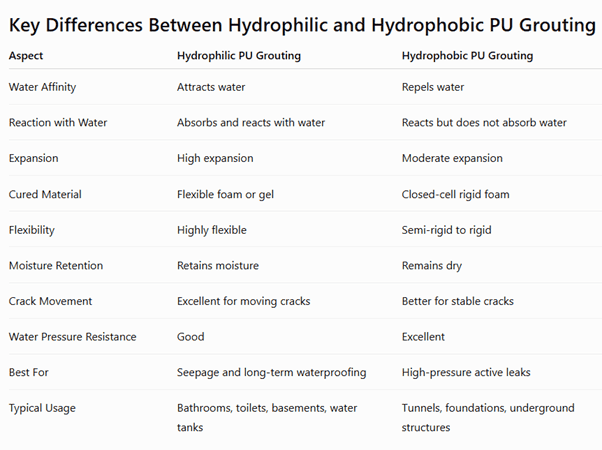
Hydrophilic PU grouting is a polyurethane resin that has a strong affinity for water. The term “hydrophilic” literally means “water-loving.”
When injected into cracks, joints, or voids where water is present, the resin reacts with the water and expands into a flexible foam or gel-like material. During the curing process, it absorbs and retains moisture, creating a permanent watertight seal.
Hydrophilic PU grout can expand many times its original volume and remains slightly flexible after curing, allowing it to accommodate minor structural movement without cracking.
Characteristics of Hydrophilic PU Grout
- Reacts directly with water to initiate expansion.
- Absorbs and retains water after curing.
- Produces a flexible and elastic seal.
- Excellent for sealing fine cracks and capillary leaks.
- Can expand significantly to fill voids and leakage pathways.
- Suitable for long-term waterproofing applications.
Ideal Applications for Hydrophilic PU Grouting
Hydrophilic PU grouting is commonly used for:
- Active water leakage in toilets and bathrooms.
- Basement wall seepage.
- Underground structures.
- Lift pits.
- Retaining walls.
- Water tanks.
- Swimming pools.
- Tunnels.
- Concrete cracks with continuous moisture exposure.
Because it maintains contact with water and remains flexible, hydrophilic PU is often considered the preferred solution for locations experiencing ongoing water ingress.
What Is Hydrophobic PU Grouting?
Hydrophobic PU grouting is a polyurethane resin that repels water. The term “hydrophobic” means “water-fearing.”
Unlike hydrophilic PU, hydrophobic PU reacts with water but does not absorb it. Instead, it forms a rigid or semi-rigid closed-cell foam structure that pushes water away and creates a waterproof barrier.
Once cured, hydrophobic PU remains dry and does not swell further when exposed to moisture.
Characteristics of Hydrophobic PU Grout
- Repels water rather than absorbing it.
- Creates a dense closed-cell foam.
- Forms a rigid or semi-rigid waterproof barrier.
- Fast reaction time during active leakage situations.
- Lower expansion ratio compared to some hydrophilic systems.
- Excellent resistance to water pressure.
Ideal Applications for Hydrophobic PU Grouting
Hydrophobic PU grouting is commonly used for:
- High-pressure active water leaks.
- Underground tunnels.
- MRT structures.
- Deep basements.
- Large concrete voids.
- Foundation walls.
- Construction joints.
- Manholes.
- Sewer systems.
It is particularly effective when immediate water stoppage is required under significant hydrostatic pressure.
Which PU Grouting Method Is Better?
The most effective choice depends on the source of the leak, crack condition, water pressure, and structure type.
Choose Hydrophilic PU Grouting When:
- Water seepage is slow or moderate.
- Cracks may experience movement.
- Long-term flexibility is required.
- The area remains constantly damp.
- Waterproofing repair is needed in toilets, bathrooms, balconies, and residential structures.
Choose Hydrophobic PU Grouting When:
- Water is flowing aggressively through cracks.
- High hydrostatic pressure exists.
- Immediate leak stoppage is required.
- Large underground structures are involved.
- The structure is relatively stable with minimal movement.
Professional waterproofing contractors often use both hydrophilic and hydrophobic PU grouting systems together as part of a comprehensive and long-lasting water leakage repair strategy. Since each type of polyurethane grout has its own unique properties and advantages, combining the two allows contractors to effectively address both immediate water ingress and long-term waterproofing performance. In many cases, hydrophobic PU grout is injected first to quickly react with water and stop heavy or high-pressure water flow by forming a dense, closed-cell barrier. Once the active leakage has been controlled, hydrophilic PU grout is injected into the finer cracks, voids, and capillary pathways. Its ability to absorb moisture and remain flexible after curing enables it to create a durable waterproof seal that can accommodate minor structural movement and provide long-term protection against future water seepage.
This combination approach is widely adopted in Singapore for complex waterproofing and leakage repair projects involving basements, retaining walls, lift pits, underground structures, roof slabs, toilets, bathrooms, water tanks, and other reinforced concrete structures experiencing severe water ingress. By utilising the strengths of both materials, professional waterproofing contractors can achieve a more reliable and comprehensive repair solution that not only stops active leaks but also helps prevent recurring water infiltration.
Although both hydrophilic and hydrophobic PU grouting are highly effective waterproofing repair methods, they are designed to serve different purposes. Hydrophilic PU grout is ideal for sealing damp cracks and persistent water seepage because it reacts with moisture, remains highly flexible after curing, and continues to maintain contact with water, making it well suited for long-term waterproofing applications. In contrast, hydrophobic PU grout is specifically engineered to stop active, high-pressure water leaks. It cures into a dense closed-cell foam that repels water and provides an immediate waterproof barrier, making it the preferred choice for situations where rapid leak stoppage is required. When used individually or in combination, both PU grouting systems offer highly effective solutions for resolving water leakage problems, provided the appropriate material is selected based on the site’s conditions and the nature of the leak.
Engage a Professional Waterproofing Specialist to address the water leakages
A professional waterproofing specialist will assess the severity of the leak, crack condition, water pressure, and structural movement before determining the most appropriate PU injection grouting method. Selecting the correct material is crucial to achieving a durable, long-lasting waterproofing solution and preventing recurring water leakage problems.
Whether the repair requires Hydrophilic PU Grouting, Hydrophobic PU Grouting, or a combination of both, the long-term success of the waterproofing work depends on accurate diagnosis, proper material selection, and correct injection techniques. Simply choosing one type of PU resin over another does not guarantee a lasting solution. The root cause of the water leakage—whether it is due to structural cracks, failed waterproofing membranes, construction joints, or water ingress under hydrostatic pressure—must first be properly identified.
For homeowners, recurring leaks in bathrooms, toilets, balconies, walls, ceilings, or roofs can lead to mould growth, concrete deterioration, peeling paint, and costly repairs if left unresolved. Maintenance teams responsible for commercial and industrial buildings need reliable repair methods that minimise disruption while providing durable waterproofing performance. Property owners and building managers must also ensure that leakage issues are repaired correctly to protect the property’s structural integrity, maintain its value, and reduce future maintenance costs.
Regardless of whether Hydrophilic PU or Hydrophobic PU grouting is ultimately the most suitable solution, it is always advisable to engage an experienced waterproofing specialist. A professional contractor has the expertise to investigate the source of the leak, evaluate the site’s conditions, recommend the most appropriate PU injection grouting system, and carry out the repair using proven waterproofing techniques.
By engaging a qualified waterproofing professional, homeowners, maintenance teams, and property owners can be confident that the underlying cause of the leakage is properly addressed, helping to prevent recurring water ingress and ensuring a safe, dry, and durable structure for years to come.
If you’re experiencing recurring water leakage, damp walls, ceiling seepage, bathroom leaks, or water ingress in your property, don’t wait until the damage becomes more extensive and costly to repair. Early intervention can help prevent structural deterioration, mould growth, peeling paint, and expensive restoration works.
At SWC Construction, we experienced waterproofing specialists are trained to accurately identify the source of the leak and recommend the most effective PU grouting solution—whether it requires hydrophilic PU, hydrophobic PU, or a combination of both. Using proven non-hacking waterproofing techniques, quality materials, and professional injection equipment, we deliver reliable, long-lasting leakage repair solutions for HDB flats, condominiums, landed homes, commercial buildings, and industrial properties across Singapore.
Contact SWC Construction today to arrange a professional site assessment and let our team help you restore a dry, safe, and leak-free property with confidence.