

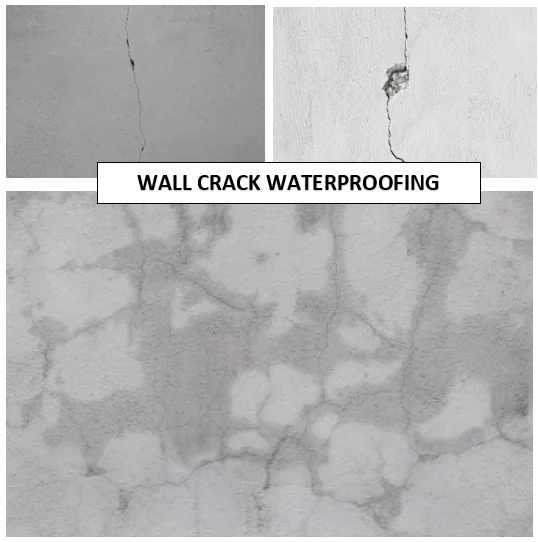
Wall crack waterproofing is the repair of cracks and defective joints in a wall so that water can no longer pass through them. The right method depends on three things: whether the crack is wet or dry, whether it is still moving, and whether it is on the inside or the outside of the building. Water-bearing cracks in concrete are usually sealed from within by PU injection grouting, while porous or widely cracked wall surfaces are protected with a surface waterproofing system. Many walls need both.
Wall cracks are a common problem in Singapore properties, affecting HDB flats, condominiums, landed houses and commercial buildings. While some cracks are only minor surface defects, others become pathways for water seepage, resulting in damp walls, peeling paint, brown water stains and more serious waterproofing problems.
For homeowners and property owners, finding a crack on a wall usually raises the same questions:
- Is the crack merely cosmetic, or is it letting rainwater into the building?
- Will the crack become wider over time?
- Can it be repaired without hacking the wall?
- Most importantly, which waterproofing solution will stop the leakage from coming back?
These questions matter in Singapore, where buildings take more than 2,000 mm of rain a year, frequent heavy thunderstorms, wind-driven rain during the monsoon seasons, high humidity and strong daytime heat. Over time, hot/cold expansion, concrete shrinkage, building movement and deteriorated sealants all contribute to wall cracks and waterproofing failure.
However, not every wall crack needs the same repair. Some only need surface treatment, while others need PU injection grouting to seal water-bearing cracks within the concrete. This guide explains how to read a wall crack, what causes it, the signs that water is getting through, and how to choose between PU injection and surface waterproofing.
What Is Wall Crack Waterproofing?
Wall crack waterproofing refers to the repair and treatment of cracks, gaps and defective areas on walls to prevent water from penetrating the building structure.
Walls face different conditions depending on where they are. External walls are constantly exposed to rainwater, sunlight and temperature changes, while internal walls may be affected by bathroom leakage, concealed pipe leaks or moisture from adjoining areas.
When cracks develop, water can enter through these openings and travel into the concrete or masonry. Even a small hairline crack can become a water entry point, particularly when the wall is repeatedly wetted by rain or daily use.
Wall crack waterproofing is therefore not simply about covering visible cracks with paint or sealant. The cause, depth and condition of the crack must be understood first, before a suitable waterproofing treatment is chosen. For example:
- A small surface crack on an internal plaster wall may only need suitable crack filling and surface waterproofing.
- A water-bearing crack within a concrete wall may need PU injection grouting.
- A deteriorated external wall joint may need the old sealant removed and replaced.
- Widespread water seepage through an external wall may need a full surface waterproofing system.
The objective is to find the actual water pathway and repair it, rather than hide the visible defect.
How to Read a Wall Crack: Width, Movement and Pattern
Before any repair, a good inspection looks at four things: how wide the crack is, whether it is still moving, the direction it runs in, and whether water is passing through it.
Crack Width
Building surveyors commonly grade wall cracks by width, using categories similar to the widely used BRE Digest 251 classification:
| Crack width | Description | What it usually means |
|---|---|---|
| Up to 0.1 mm | Hairline | Usually cosmetic, but can still let water through if it runs through a concrete wall that is regularly wetted. |
| Up to 1 mm | Very slight | Common shrinkage or thermal cracking. Seal and protect if water is getting in. |
| 1 to 5 mm | Slight | Needs a proper waterproofing repair and monitoring to see whether it is growing. |
| 5 to 15 mm | Moderate | Have it assessed by a qualified building or structural professional before waterproofing. |
| Over 15 mm | Severe | A structural matter first. Waterproofing comes after the cause is resolved. |
Width alone does not decide the repair. A 0.2 mm crack that runs right through a concrete wall can leak more than a wider crack in the plaster only.
Active or Dormant?
An active crack still opens and closes, for example with daily temperature changes or building movement. A dormant crack has stopped moving.
A simple way to check at home: mark both ends of the crack with a pencil, write the date beside it, and measure the width with a crack-width card or a ruler. Check again after four to eight weeks. If the crack has grown longer or wider, it is active.
This matters for the repair. Active cracks need flexible materials, such as polyurethane (PU) grout or an elastomeric sealant, that can move with the wall. Rigid fillers and cement-based patches tend to crack again along the same line. Where a dormant crack needs its structural strength restored, an engineer may specify epoxy injection instead. Epoxy bonds the concrete together but is rigid and is not designed to stop flowing water.
Crack Direction and Pattern
- Vertical hairline cracks are often caused by shrinkage of the concrete or plaster.
- Diagonal cracks from the corners of windows and doors often come from stress concentrating at openings, or from building movement.
- Horizontal cracks along a beam or slab line often appear where two different materials meet and move differently.
- Map or “crazing” cracks, a fine net of cracks across the surface, usually affect the plaster or render rather than the wall behind it.
These patterns are a guide, not a diagnosis. A crack that is widening, has displaced edges, or appears together with sticking doors and windows should be assessed by a professional.
Wet or Dry?
The last question is whether water is actually passing through the crack. Look at the crack, and the wall around it, after heavy rain: dampness, brown stains or white deposits along the crack line suggest an active water pathway. The signs are explained in more detail below.
Common Causes of Wall Cracks in Singapore Buildings
Wall cracks develop for several reasons. Understanding the cause matters, because the wrong repair method may only give temporary relief. (For a wider look at crack causes, see our guide to the causes and remedies of wall cracks.)
1. Hot and Cold Expansion and Contraction
Singapore is warm all year, and buildings are exposed to strong sun followed by sudden cooling from rain. Concrete, plaster, sealants and other construction materials expand when heated and contract when cooled. Repeated hot/cold movement creates stress within building materials, particularly at joints and where different materials meet.
Over time, this movement contributes to hairline cracks, wall joint cracks and sealant deterioration. External walls facing the afternoon sun experience the largest temperature swings. If the original sealant becomes brittle or loses adhesion, gaps develop and let rainwater in.
2. Concrete Shrinkage and Ageing
Concrete naturally shrinks as it cures and loses moisture. If shrinkage is not well controlled, small cracks develop within the concrete.
As buildings age, existing cracks become more noticeable through repeated wetting and drying and wear of the surface finish. In some cases, unsuitable repair materials or poorly detailed construction joints also contribute to cracking.
3. Building Settlement and Structural Movement
Buildings can move gradually due to foundation settlement, structural loading and changes in building conditions. This movement can create cracks around:
- Door and window openings.
- Wall corners and junctions.
- Concrete beams and columns.
- Connections between different building materials.
- Structural and non-structural wall sections.
Not all movement cracks are waterproofing defects. However, if a crack runs through the wall and creates an opening, it can become a pathway for water.
Where cracks are wide, growing or accompanied by signs of structural distress, a qualified building or structural professional should assess them before any waterproofing repair.
4. Poor Workmanship During Construction
Poor workmanship can contribute to wall cracks and waterproofing failure. Examples include inadequate surface preparation, improper plastering, insufficient curing and unsuitable joint detailing.
A hairline crack or a crack along a poorly finished wall joint may seem minor at first. If water enters through it, the problem can gradually develop into persistent wall seepage.
5. Deteriorated Sealant and Wall Joint Cracks
Sealants are used around windows, external wall joints and connections between different building materials. Over time, sealant deteriorates through UV exposure, ageing, moisture and repeated movement. Sealant worn off due to heat expansion leaves small openings between joints.
These openings let rainwater in, particularly during heavy or wind-driven rain. Replacing deteriorated sealant and properly waterproofing the affected joints helps prevent further water penetration.
Signs That Water Is Seeping Through Wall Cracks
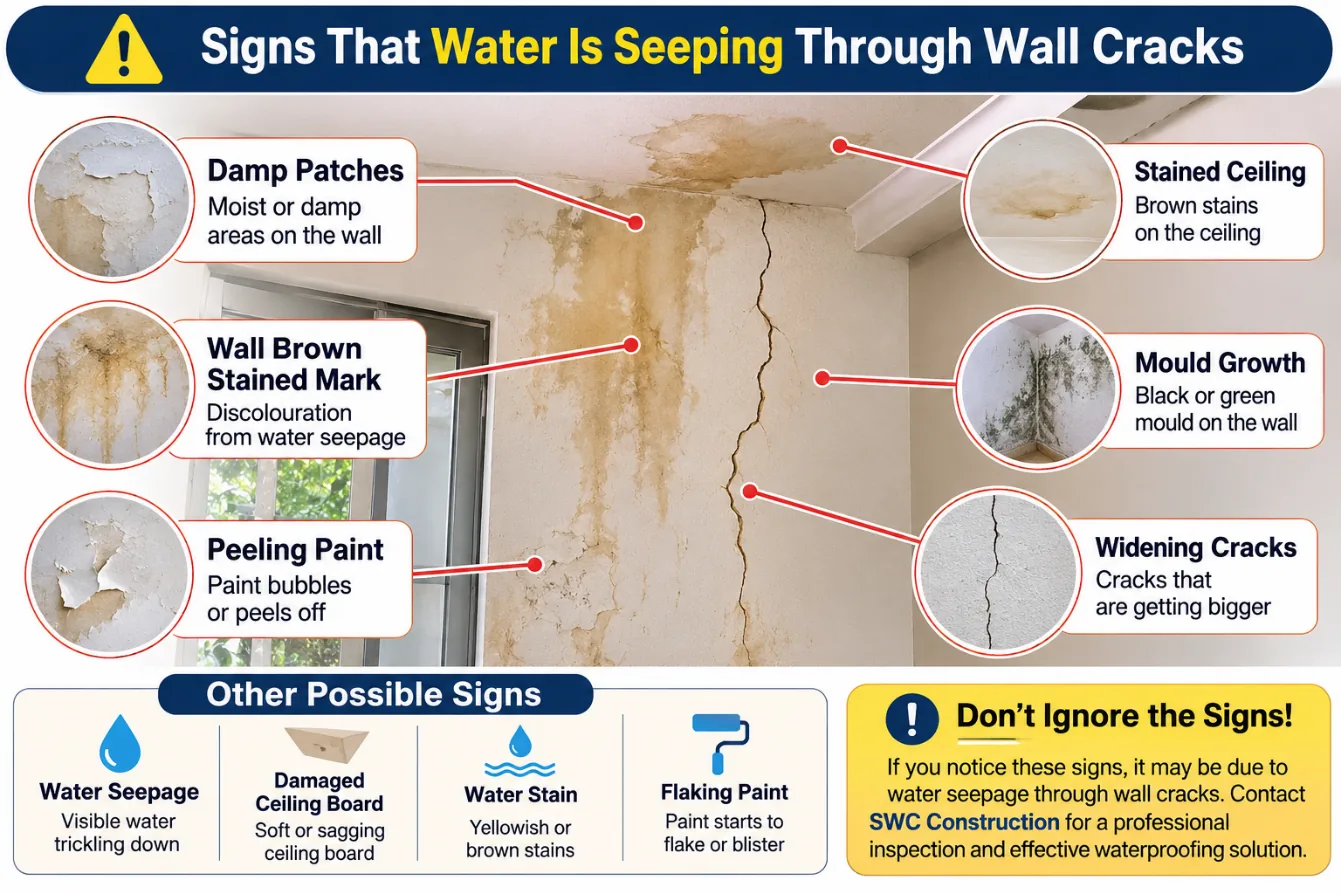
One of the biggest concerns for property owners is telling whether a wall crack is just a surface defect or a sign of water leakage. Seepage often does not show immediately: moisture can build up inside the wall for weeks before visible signs appear.
Here are the common warning signs to look out for:
Brown or Yellowish Water Stains
A wall brown stained mark may indicate that moisture is travelling through the wall and carrying dissolved minerals or other deposits to the surface. These stains often become more noticeable after heavy rainfall.
Peeling or Bubbling Paint
When moisture is trapped behind wall paint, the paint begins to bubble, blister or peel. Repainting without dealing with the source of the seepage is unlikely to last.
Persistent Damp Patches
Some walls stay damp even in dry weather. This can point to continuous water penetration, a concealed pipe leak or moisture trapped within the concrete. Dampness near the bottom of a wall can also be rising damp, which needs a different approach.
White Powdery Deposits (Efflorescence)
White powdery deposits, known as efflorescence, appear when water travels through masonry or concrete and carries soluble salts to the surface. They are a clear sign that moisture is moving through the wall.
Mould and Musty Smells
Persistent moisture creates good conditions for mould. Homeowners may notice dark patches, musty smells and deteriorating wall finishes. If these keep returning despite cleaning and repainting, further investigation is recommended.
Stains or Cracks on the Ceiling Below
Water entering through a wall crack can travel along the slab and appear somewhere else, often as a stain or hairline crack in the ceiling of the room or unit below.
Simple Checks Before You Call a Contractor
- Check after heavy rain: if the damp patch appears or grows after rain, an external wall crack or joint is a likely entry point.
- Check in dry weather: if the wall stays damp with no rain, a concealed pipe leak or a neighbouring wet area is more likely.
- Check the water meter: turn off all taps and see whether the meter still moves. If it does, a pipe may be leaking.
- Note the location: dampness next to a bathroom, kitchen or planter box often comes from that wet area, not from the crack itself.
These signs do not automatically confirm that a wall crack is the source of the leak. Other sources should be ruled out before deciding on the repair method. For leaks through the outside of the building, see also our guide to external wall leakage repair.
Wall Crack Waterproofing Solutions
There are several ways to repair wall cracks and stop water penetration. The right solution depends on the crack’s condition, whether water is actively flowing, the wall material and the location of the leak. For most situations, the two main options are PU injection grouting and surface waterproofing.
PU Injection Grouting
PU injection grouting is a commonly used waterproofing solution for water-bearing cracks, joints and leakage pathways within concrete. It is particularly useful when water is coming through cracks that a surface coating cannot effectively treat.
The process involves injecting polyurethane resin into the crack under controlled pressure. Depending on the formulation and moisture conditions, the resin reacts, expands to fill the gaps and seals the water pathway from within.
How PU Injection Grouting Works
A typical repair process includes:
- Site inspection: identify the suspected leakage area and assess the crack’s width, depth, movement and moisture.
- Drilling injection holes: small holes are drilled along the crack, typically at an angle so they cross the crack inside the wall, and usually on alternating sides of it. Spacing depends on the wall thickness and crack width.
- Installing injection packers: packers (small one-way valves) are fitted into the holes to control the injection.
- PU resin injection: the resin is injected under controlled pressure, usually starting from the lowest packer and moving up as the resin appears at the next one.
- Reaction and curing: the resin reacts with moisture and expands to fill the crack and seal the leakage pathway.
- Finishing works: once cured, the packers are removed, the holes are patched and the surface is made good or repainted where required.
Hydrophilic vs Hydrophobic PU Grout
There are two main families of PU grout, and choosing the right one is part of a good repair:
- Hydrophilic PU absorbs water and swells as it cures. It suits cracks that stay damp most of the time.
- Hydrophobic PU repels water and cures into a closed-cell foam that is less affected by wetting and drying. It suits active leaks with flowing water and cracks that dry out between rain.
The choice depends on the site conditions, which is why an inspection comes before the quotation.
Benefits of PU Injection Grouting
- Non-hacking waterproofing method: in suitable situations, it avoids removing large areas of wall tiles, plaster or concrete.
- Targets the leakage pathway: the resin goes into the crack and gaps within the concrete, where the water actually travels.
- Works on active water seepage: certain PU materials are designed to react in the presence of water and help stop active leaks.
- Minimises disruption: particularly useful for occupied HDB flats, condominiums and operating commercial buildings.
- Localised repair: treatment can focus on the affected crack rather than the whole wall.
However, cosmetic surface cracks, unstable structural cracks and cracks caused by unresolved building movement may need a different approach.
Surface Waterproofing
Surface waterproofing involves applying waterproofing materials directly onto the wall to create a protective barrier against water. It is commonly used for external walls, internal wet areas and surfaces where the existing waterproofing protection has deteriorated.
Unlike PU injection grouting, which seals cracks and leakage pathways from within, surface waterproofing protects the exposed face of the wall.
How Surface Waterproofing Works
A typical surface waterproofing process includes:
- Surface inspection: identify cracks, damaged coatings, defective joints and areas of water penetration.
- Surface preparation: remove loose paint, deteriorated coatings, dust and other contaminants.
- Crack and joint repair: fill surface cracks and repair defective joints with suitable materials.
- Waterproofing application: apply the selected membrane or coating in the number of coats and thickness the manufacturer requires.
- Curing and protection: allow enough curing time before any protective or decorative finish.
Common Surface Waterproofing Systems for Walls
- Cementitious crack-bridging coatings: bond well to concrete and plaster, and are often used in internal wet areas and on external concrete.
- Elastomeric acrylic or PU wall coatings: flexible, UV-resistant coatings that stretch over hairline cracks and are often used on external walls.
- Penetrating water repellents (silane/siloxane): soak into porous masonry and keep rain out while letting the wall breathe. They do not bridge open cracks, so cracks must be repaired first.
- Joint sealant replacement: old sealant is cut out, a backer rod and primer are installed, and a new flexible sealant is applied.
For the external walls of high-rise and multi-storey buildings, this work is often done by rope access waterproofing, which avoids the cost and disruption of full scaffolding.
Benefits of Surface Waterproofing
- Protects the wall surface: creates a barrier against rainwater and moisture.
- Covers multiple surface defects: suitable for broad areas with many cracks, porous surfaces or worn coatings.
- Useful for external walls: helps protect exposed concrete and plaster from weather-related water penetration.
- Preventive maintenance: worth considering when the existing protection is wearing out.
- Improves the surface condition: depending on the system, it can be followed by a decorative finish.
However, surface waterproofing may not stop water travelling through deeper cracks or internal concrete pathways. If water keeps entering through the structure, another coat on the surface may only give temporary relief.
PU Injection vs Surface Waterproofing: Which Is Better?
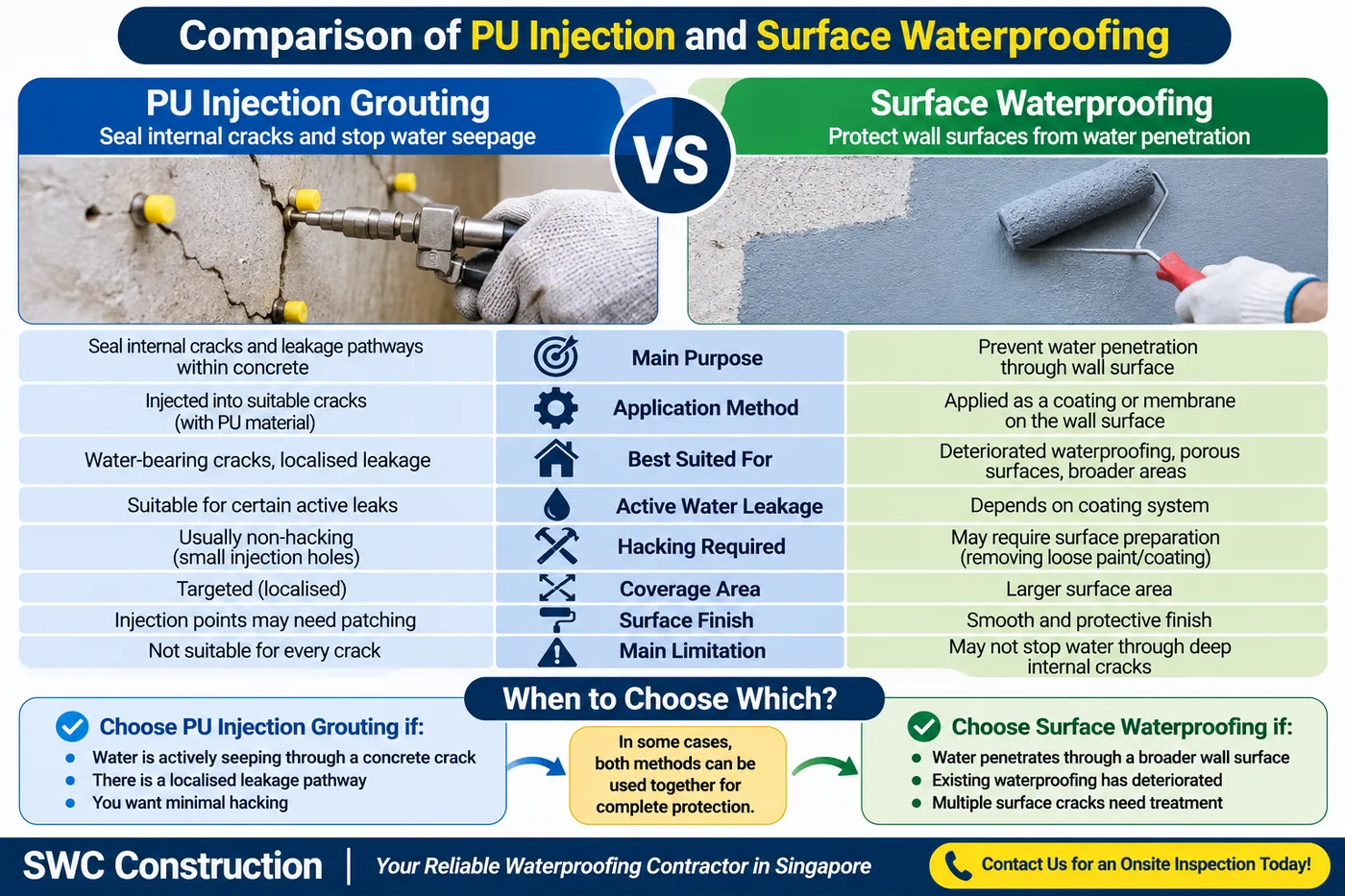
Both PU injection grouting and surface waterproofing are proven methods, but they do different jobs. The main difference is that PU injection grouting seals cracks and water pathways inside the concrete, while surface waterproofing protects the exposed wall surface. Choosing the wrong one may not solve the actual leak.
| Comparison | PU Injection Grouting | Surface Waterproofing |
|---|---|---|
| Main purpose | Seal internal cracks and leakage pathways | Protect wall surfaces against water penetration |
| Application | Injected into cracks within the concrete | Applied onto the prepared wall surface |
| Best suited for | Water-bearing cracks and localised concrete leakage | Surface deterioration, porous walls and broad exposed areas |
| Active water leakage | Suitable PU materials can treat certain active leaks | Depends on the system; usually needs a dry, sound surface |
| Hacking | Often avoids extensive hacking | Needs surface preparation and removal of defective coatings |
| Coverage | Localised crack or leakage pathway | Larger surface areas |
| Surface finish | Injection points need patching and repainting | May need a protective or decorative finish |
| Main limitation | Not suitable for every crack, especially unstable structural defects | May not stop water travelling through deep internal cracks |
When to Choose Each Method
| Situation | PU Injection Grouting | Surface Waterproofing |
|---|---|---|
| Water leakage condition | Water actively seeping through concrete cracks | Water penetrating through exposed wall surfaces |
| Type of cracks | Through-cracks and water-bearing cracks within concrete | Many surface cracks, micro cracks and porous areas |
| Leakage location | Localised leakage in concrete walls or slabs | Broad wall surfaces, particularly external walls |
| Existing waterproofing | Water enters through internal cracks or pathways | The existing membrane or coating has worn out |
| Treatment method | PU resin injected to seal internal pathways | Coating or membrane applied to the prepared surface |
| Hacking | Generally non-hacking, with small injection holes only | May need removal of paint, loose coatings or damaged finishes |
| Main objective | Stop water passing through internal cracks | Stop water penetrating the exposed surface |
| Typical application | Concrete wall cracks, slab leakage and localised seepage | External walls, worn waterproofing and porous concrete |
In many cases, using both PU injection grouting and surface waterproofing gives the most complete result. PU injection seals the cracks and pathways inside the wall, while surface waterproofing adds a protective layer that stops new water from getting in. Combining both treats the existing seepage and reduces the risk of future leaks, depending on the wall’s condition and the actual source of water ingress.
Who Is Responsible for Wall Cracks in HDB Flats and Condominiums?
Before arranging repairs, it helps to know who looks after the wall:
- HDB flats: the external walls of an HDB block are common property, usually maintained by the Town Council, so cracks there should be reported to them. Walls and finishes inside your flat are generally the owner’s responsibility.
- Condominiums: external walls and the main structure are usually common property managed by the MCST, while walls and finishes within a unit are generally the owner’s. Check your strata plan and by-laws, and speak to the management office early. Our guide for condominium and MCST waterproofing explains the usual process.
- Landed houses: the owner is responsible for the whole building, including external walls and shared party walls (agree shared repairs with the neighbour).
- Commercial buildings: responsibility follows the lease and the building management arrangement.
When to Engage a Professional Waterproofing Contractor
Some minor surface cracks can be handled with simple cosmetic repairs. However, when cracks come with water seepage, persistent dampness or visible deterioration, a professional investigation is recommended. Consider engaging a waterproofing contractor when:
- Water keeps seeping through the wall after repainting or surface repairs.
- Brown or yellowish stains keep appearing on the same wall.
- Wall cracks become wider or longer over time.
- External walls show signs of rainwater penetration.
- Dampness develops near bathrooms, toilets or water points.
- Water leakage affects neighbouring units or the unit below.
- There are recurring ceiling leaks or inter-floor leak complaints.
- Previous waterproofing works did not resolve the leakage.
For large cracks, cracks that keep growing, or cracks with displacement or other signs of structural distress, arrange a structural assessment before any cosmetic or waterproofing repair.
Early investigation prevents further damage. Unresolved seepage can lead to damaged finishes, mould, deteriorating plaster and, over time, spalling concrete as the steel reinforcement inside starts to rust. For MCST management teams and commercial building maintenance personnel, dealing with recurring leakage complaints early also reduces repeated repair costs and disruption to residents and tenants.
Frequently Asked Questions About Wall Crack Waterproofing
Is a hairline crack in a wall serious?
Most hairline cracks (under about 0.1 mm) are cosmetic, often caused by shrinkage of the plaster or concrete. A hairline crack becomes a concern when it lets water through, keeps growing, or appears with stains, damp patches or efflorescence. Mark and date it, and check it again after a few weeks and after heavy rain.
Can I seal a wall crack myself with sealant or waterproof paint?
For a dry, stable hairline crack on an internal wall, filling it and repainting is usually fine. For a crack that is letting water in, a surface sealant or waterproof paint usually only hides the problem: water keeps travelling through the crack behind it and the stain comes back. Water-bearing cracks need the pathway itself sealed.
Does PU injection grouting require hacking?
In suitable cases, no. PU injection only needs small drilled holes along the crack, which are patched after the treatment, so tiles, plaster and finishes can usually stay in place.
How long does wall crack waterproofing take?
It depends on the method, the size of the area and the weather. Most of our jobs take an estimated 1 to 3 days. External surface waterproofing can take longer, because coatings need dry weather to be applied and cured.
How long does the repair last?
With proper care, a waterproofing repair typically lasts 10 to 25 years or more, depending on the method, the materials and how the building is maintained.
Which is better for wall cracks: PU injection or surface waterproofing?
Neither is better in every case. PU injection is better for water coming through cracks in concrete. Surface waterproofing is better for porous or widely cracked wall surfaces. Many external walls need both: injection for the leaking cracks, then a surface system to protect the whole wall.
Why Choose SWC Construction for Wall Crack Waterproofing
Finding the right waterproofing contractor in Singapore matters most when wall cracks and seepage keep coming back despite earlier repairs. HDB flats, condominiums, landed houses and commercial buildings each need a different approach.
At SWC Construction, we know that every leak is different. Covering the visible crack does not solve the problem if the real source of water has not been found. Our waterproofing services include:
- PU injection grouting for concrete cracks and leakage pathways.
- Surface waterproofing for worn or exposed wall surfaces.
- Concrete crack repair and leakage rectification.
- Wall and ceiling waterproofing.
- Water seepage investigation and repair.
- Non-hacking waterproofing solutions and customised treatments.
SWC Construction is a BCA-registered contractor (workhead CR13) and is bizSAFE Level 3 certified, and an HDB-appointed waterproofing contractor. We are rated 4.9 stars from more than 900 reviews: you can read our Google reviews to see what customers say about our work. Our repairs come with a 1-year warranty, up to 3 years depending on the service. And if the leak is not resolved, you don’t pay (terms and conditions apply).
Our approach is simple: understand the leakage problem, inspect on site, identify the source of water penetration, and recommend the most suitable repair for the actual site conditions.
Whether you are a homeowner, a property owner, an MCST management team or a commercial building manager, we are ready to help with your waterproofing needs.
Don’t let a small wall crack turn into a bigger water leakage problem. Contact SWC Construction today to arrange an on-site inspection. Our team will assess your wall cracks, investigate the possible sources of water leakage and recommend a waterproofing repair suited to your property’s actual condition.
SWC Construction: your reliable waterproofing contractor in Singapore.