

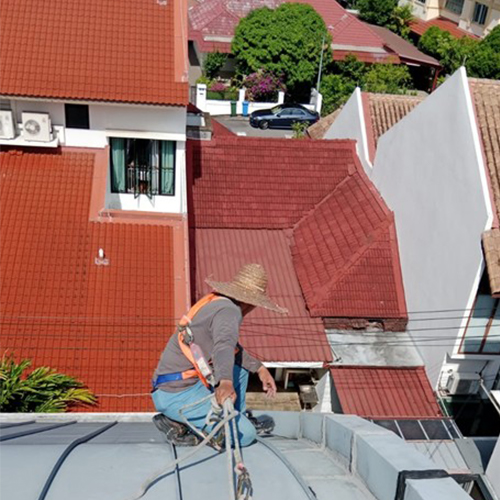
Roof waterproofing is an important part of maintaining a landed property in Singapore. Many homeowners only start thinking about waterproofing when they notice water dripping from the ceiling, a wall brown stained mark, peeling paint, dampness or water seepage after heavy rain.
By the time these signs become visible, however, the roof may already have a waterproofing problem that has been developing for some time.
A roof does not necessarily need to have a large visible hole before water can enter. Rainwater can find its way through very small openings, including micro cracks, concrete hairline cracks, deteriorated joints, failed sealants and areas where the waterproofing membrane has deteriorated.
More importantly, the location where water appears inside the property may not be the actual location where it entered.
Water can travel through concrete slabs, joints, walls and other building components before eventually appearing on a ceiling or internal wall. This is why repairing the visible stain alone may not solve the problem.
For landed property owners in Singapore, an effective roof waterproofing approach should therefore begin by understanding the possible sources of water leakage. The objective is to identify how water is entering the property, determine the condition of the roof and select the appropriate waterproofing solution treatment.
The roof is one of the most exposed areas of a landed property. Every day, it can be exposed to sunlight, rain, humidity, wind and changing temperatures. Singapore’s tropical climate means that roof surfaces can experience intense heat followed by periods of heavy rainfall. This creates an ongoing climate/weather concern for exposed building materials. Over time, repeated environmental exposure can affect concrete, waterproofing membranes, sealants, joints, roof tiles and other components.
One of the factors that should be considered is hot/cold expansion. Materials exposed to changes in temperature expand and contract. While this movement may be small during an individual temperature change, repeated movement over many years can contribute to stress around joints, cracks, connections and different materials.
This can become particularly important in older landed properties.
A roof that was waterproof when it was first constructed may not remain in the same condition decades later. The waterproofing layer may deteriorate, sealants may become brittle, concrete may develop cracks and drainage may become less effective.
This gradual deterioration can eventually result in:
- Rain water seepage
- Roof leakage
- Concrete leak
- Ceiling leakage
- Damp walls
- Peeling paint
- Mould
- Water stains
- Waterproofing failure
- Concrete deterioration
Roof waterproofing therefore should be viewed as part of the property’s long-term maintenance rather than simply an emergency repair.
Common Causes of Roof Leakage in Landed Properties
Understanding the possible causes of leakage helps homeowners make better decisions when selecting a waterproofing contractor.
1. Concrete Cracks and Micro Cracks
Concrete is widely used for roof slabs because it provides strength and durability. However, concrete can develop cracks over time.
Some cracks are caused by shrinkage, while others may be associated with building movement, temperature changes, loading, construction conditions or deterioration.
The cracks may initially be extremely small.
These micro cracks can be difficult for a homeowner to identify, especially when they are covered by coatings, screed or other finishes.
However, when rainwater reaches an opening, even a relatively small defect can become a pathway for water penetration.
The risk can become more noticeable when the roof experiences heavy rainfall or prolonged water ponding.
This does not mean that every hairline crack will automatically cause leakage. Instead, the condition, location and behaviour of the crack should be assessed together with the surrounding waterproofing system.
2. Wall Cracks and Wall Joint Cracks
Another possible source of leakage is the wall surrounding the roof area.
For example, landed properties may have parapet walls, roof perimeter walls, raised structures or roof extensions.
Water can enter through wall cracks or wall joint cracks, particularly where different components meet.
The junction between a roof slab and a wall is an area that deserves particular attention because movement can occur between the different materials.
If the joint or sealant deteriorates, rainwater may enter behind the surface. The water may then travel into the wall or roof slab before becoming visible inside the property.
This is why homeowners should not assume that a ceiling stain directly below a roof means the centre of the roof is the problem.
The perimeter, parapet and wall junctions should also be investigated.
3. Waterproofing Membrane Worn Out
A waterproofing membrane worn out through age is another common reason for roof leakage.
Waterproofing membranes are designed to prevent water from penetrating into the underlying building structure. However, like other external building materials, they are exposed to weather conditions throughout their service life.
Over time, an ageing membrane may show:
- Cracks
- Blistering
- Peeling
- Loss of adhesion
- Brittle areas
- Surface deterioration
- Separation
- Visible wear
A membrane may also deteriorate faster if the roof experiences prolonged water ponding, heavy foot traffic, unsuitable repairs or other environmental stresses.
When the existing waterproofing layer has deteriorated extensively, repairing one isolated crack may not be enough.
A broader surface waterproofing treatment may need to be considered.
The contractor should first assess whether the existing waterproofing system is still suitable to remain in place or whether defective sections require removal and replacement.
4. Sealant Worn Off Due to Heat Expansion
Sealants are often used around joints, pipe penetrations, flashing, roof fixtures and other areas where different materials meet.
These areas are particularly vulnerable because the materials can move differently when exposed to temperature changes.
Over time, sealant worn off due to heat expansion can become a source of water ingress.
The sealant may become:
- Cracked
- Brittle
- Hardened
- Detached
- Shrunk
- Peeling
- Separated from the substrate
This type of seal damage can allow rainwater to enter behind the surface.
Replacing the sealant may resolve a localised defect, but the surrounding area should also be inspected.
If the underlying joint has excessive movement or another waterproofing defect exists, replacing sealant alone may not provide a long-term solution.
5. Rainwater Ponding and Drainage Problems
Good roof drainage is an important part of waterproofing.
Rainwater should be directed toward suitable drainage outlets rather than remaining on the roof for extended periods.
If a roof has inadequate falls, blocked outlets, damaged drainage systems or other drainage problems, water may accumulate.
This is known as rainwater ponding.
Rain water seepage becomes more likely when water remains around cracks, joints or defective waterproofing areas.
Homeowners should therefore look beyond the waterproofing membrane itself.
A roof can have a good waterproofing material but still experience problems if drainage is poor.
Gutters, outlets, downpipes and other drainage components should be checked when investigating recurring leakage.
6. Concrete Slab Damage, Staining and Leakage
A reinforced-concrete roof slab can experience different types of deterioration as a building ages.
Homeowners may notice concrete slab damage/stain/leak, cracking, damp areas or discolouration.
Water entering through cracks or defective waterproofing can travel into the concrete slab.
The visible symptom may eventually appear as:
- Ceiling stains
- Damp ceiling
- Peeling paint
- Mould
- Concrete leak
- Rust-coloured staining
A concrete leak should not simply be treated by covering the internal surface. The source of the water should be investigated.
If the water is entering through a crack, PU Injection may be considered for suitable conditions.
If the roof’s overall waterproofing layer has deteriorated, surface waterproofing may also be required.
One of the most frustrating situations for homeowners, is there is no obvious hole or crack lines in the roof, but water still appears on the ceiling.
The crack may be very small; it may be hidden beneath an existing coating or finish. The water may be entering through a joint or penetration rather than a crack.
Or the water may have entered from another area and travelled through the roof slab before appearing at the ceiling.
A concrete roof may appear relatively sound from the outside while still allowing water to penetrate through small cracks, construction joints, cold joints, wall-to-slab connections or other weak points. These defects may be difficult to waterproof effectively by simply applying a coating over the visible surface.
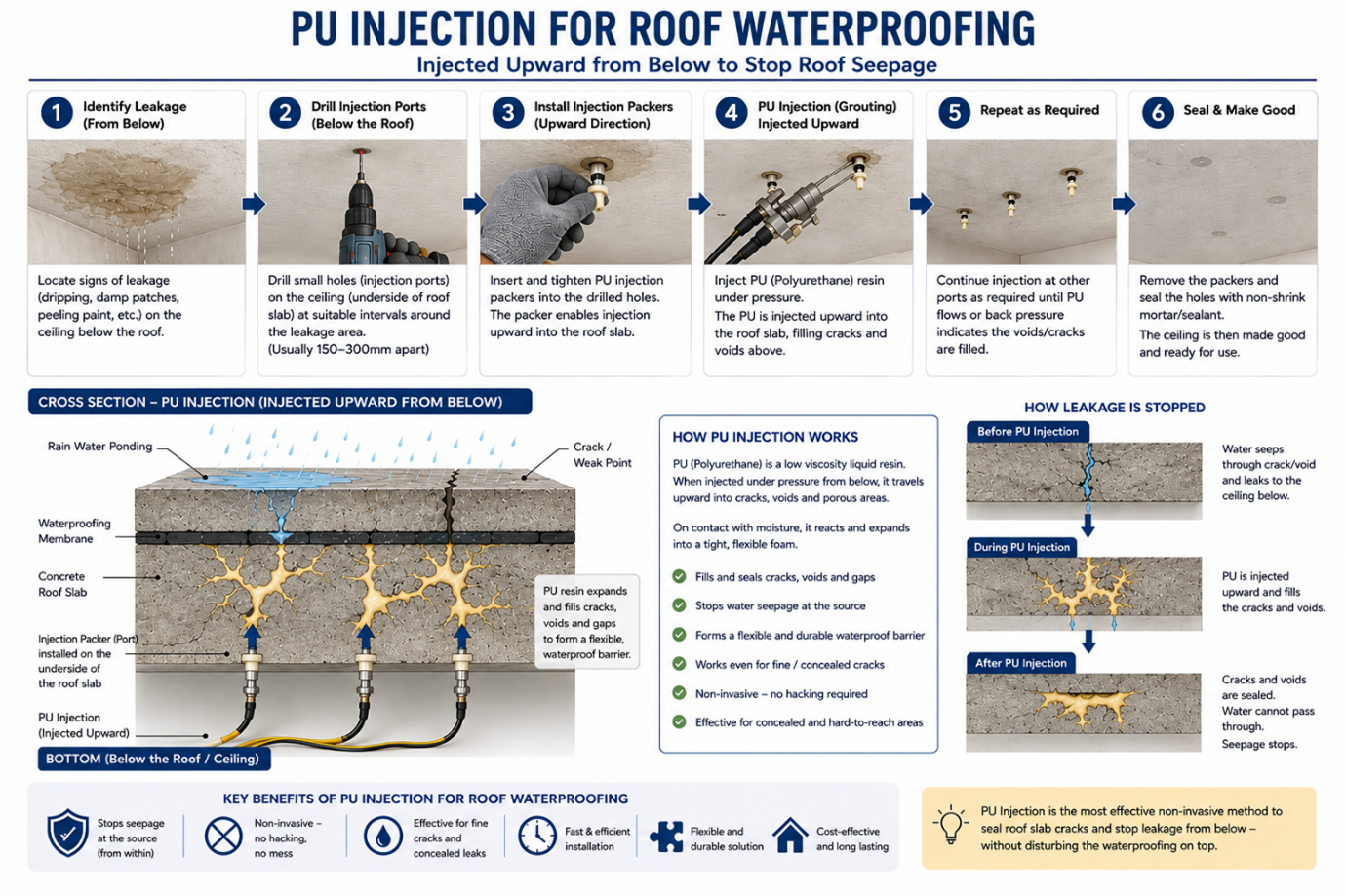
The PU Injection process generally starts with identifying the suspected leakage path. The waterproofing contractor will inspect the concrete roof, surrounding areas, cracks, joints, water stains and drainage conditions to determine where water may be entering and how it is travelling through the structure.
What Is PU Injection Grouting?
PU Injection grouting, also known as Polyurethane Injection Grouting, is a specialised waterproofing repair technique used to seal water-bearing cracks, joints, voids and concealed leakage pathways within concrete structures. For landed properties, it can be particularly useful when roof water leakage is coming through concrete roof slabs, cracks, construction joints or other areas where simply applying a waterproofing coating over the surface may not fully address the source of the leakage.
Unlike conventional surface waterproofing, which primarily forms a protective waterproof layer over the exposed roof surface, PU Injection works by introducing a polyurethane-based injection material into a prepared crack or leakage pathway. The material is injected under controlled pressure so that it can travel into the internal void, crack or water pathway. Depending on the type of PU injection material used, the polyurethane may react with moisture and expand, helping to fill irregular spaces and restrict further water movement.
This makes PU Injection particularly valuable when the visible water leak is only the symptom and the actual water pathway is located inside the concrete or behind the visible surface.
Once the leakage area has been identified, injection points are strategically positioned along the crack or suspected water pathway. Small holes may be drilled at an appropriate angle into the concrete so that injection ports, commonly known as packers, can be installed. These packers provide a controlled entry point for the PU injection material.
The injection material is then introduced through the packers using suitable injection equipment. The pressure needs to be controlled carefully. The objective is not simply to inject as much material as possible, but to allow the polyurethane to penetrate the relevant crack or void and form a continuous sealing effect along the water pathway.
Where moisture or active water is present, certain hydrophilic or hydrophobic polyurethane systems may react differently depending on their formulation. Some PU materials can expand when they come into contact with water, allowing them to occupy irregular voids and cracks that may not have a uniform shape.
After the injection has been completed and the material has sufficiently reacted or cured, the injection points can be removed or finished, and the repaired area can be treated as required.
Why Is PU Injection Useful for Landed Property Roof Waterproofing?
For a landed property, roof leakage does not always originate from a large visible crack. In many cases, water may enter through a fine micro crack, construction joint, expansion joint or small defect in the concrete roof slab. Water can then travel through the internal structure before eventually appearing as a ceiling leak or a wall brown stained mark inside the house.
The reason why simply repairing the location where water becomes visible inside the property may not solve the problem.
PU Injection provides a method of targeting certain internal water pathways directly. Instead of relying entirely on a surface coating to bridge the visible defect, the injection material can be introduced into a suitable crack or void within the concrete.
For example, imagine a landed property’s reinforced concrete roof slab has developed a small crack after years of exposure to Singapore’s weather. Rainwater enters through the crack during heavy rainfall. The water travels through the concrete and eventually appears on the ceiling below.
The crack may be relatively narrow at the roof surface, but the internal water pathway may extend further into the concrete. A properly designed PU Injection treatment can allow the waterproofing material to travel along the relevant pathway and seal areas that cannot easily be reached from the surface.
PU Injection is generally a targeted waterproofing repair rather than a complete roof waterproofing system.
If a landed property has one or several isolated water-bearing concrete cracks, PU Injection may be an appropriate component of the repair. However, if the entire roof waterproofing membrane has deteriorated, multiple areas are showing signs of failure, water ponding is occurring, or the surface waterproofing system has reached the end of its service life, injection alone may not provide adequate long-term protection.
In these situations, the roof may require a broader surface waterproofing treatment after the leakage pathways have been addressed.
This is why a professional roof waterproofing assessment should consider the overall condition of the roof rather than treating every leak as an individual crack.
For some landed property roofs, combining PU Injection grouting with surface waterproofing treatment can provide a more comprehensive approach.
PU Injection is used to address suitable internal cracks, water-bearing pathways and concealed voids. Surface waterproofing, on the other hand, protects the exposed roof surface from rainwater penetration and helps create a continuous waterproofing barrier over the treated area.
Consider an ageing concrete roof where rainwater is entering through several small cracks while the existing surface waterproofing has also deteriorated.
If only the surface is coated, the contractor may not fully address active water pathways within the concrete. If only PU Injection is performed, other exposed portions of the ageing waterproofing system may remain vulnerable to future rainwater penetration.
A combined approach can therefore involve treating suitable active leakage pathways with PU Injection first, followed by appropriate surface preparation and application of a compatible waterproofing system.
The exact sequence and materials should depend on the existing roof condition and the waterproofing system being specified.
PU Injection can provide an effective long-term waterproofing repair when it is correctly specified, properly installed and applied to a suitable leakage condition. However, no responsible waterproofing contractor should claim that PU Injection is automatically a permanent solution for every type of roof leakage.
The durability of a repair depends on factors such as the condition of the concrete, continued building movement, water exposure, joint movement, drainage, surface waterproofing condition and the quality of the installation.
If the roof continues to experience movement or the surrounding waterproofing system has deteriorated, additional treatment may be necessary.
For this reason, PU Injection should be considered as one part of a waterproofing strategy, rather than a universal solution for every roof leak.
The most effective waterproofing solution is not necessarily the one involving the most materials. It is the one that correctly identifies the source of water ingress and applies the appropriate repair method to the actual roof condition.
For an ageing landed property, PU Injection grouting can be a particularly useful technique for targeted roof waterproofing repair, especially where active water is entering through suitable concrete cracks, joints or concealed pathways. When combined appropriately with surface waterproofing treatment, it can form part of a more comprehensive strategy to reduce rainwater seepage and protect the roof structure.
Every landed property is different. Roof design, building age, previous repairs and the condition of the existing waterproofing system all affect the most suitable repair approach.
Whether you are a landed property owner, commercial building maintenance team or MCST maintenance team, early investigation can help identify the actual source of leakage and prevent recurring waterproofing problems.
At SWC Construction, we can address roof leakage, concrete leaks, PU Injection grouting and surface waterproofing treatment. According to the company’s stated credentials, SWC Construction is a BCA-registered qualified and certified waterproofing contractor, with bizSAFE Level 3 and HDB-appointed waterproofing contractor status. The company also has strong Google review feedback from clients.
Contact SWC Construction for professional waterproofing assessment and suitable solutions for roof leaks, concrete leakage, rainwater seepage and other waterproofing problems in Singapore.